


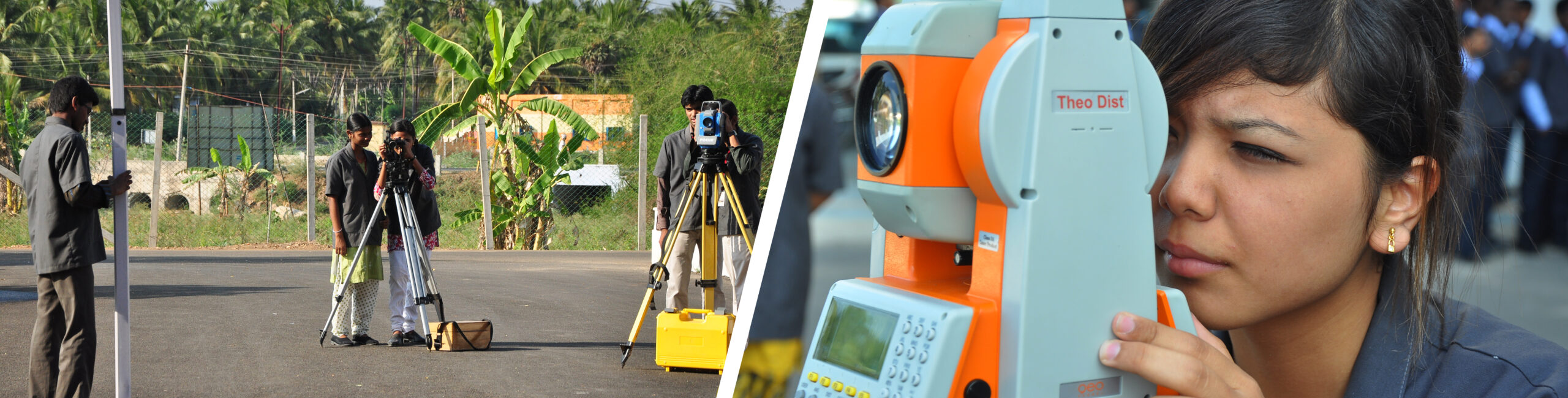
ABOUT US
Department of Civil Engineering has one UG Program (BE-Civil(2010)) and a PG program (ME-Construction Engineering and Management(2014)). Our team of faculty provides the right academic atmosphere for the students to get developed into complete Civil Engineers with aptitude for research. Students are moulded to the requirements of the industry through industry based curriculum, internships, extramural activities, Project Based Learning, outside class hours learning, Skill centric learning and Mini Projects. Quality of students and their achievements in curricular and co-curricular activities have branded our department as a leading Centre.
VISION & MISSION
VISION
- Produce competent Civil Engineering professionals with scientific temper, values, ethics, team spirit and capabilities to face new challenges.
MISSION
- Provide conducing learning environment with state-of- the-art infrastructure facilities, laboratories and teaching learning systems.
- Produce skilled Civil Engineers with skills towards employability, leadership, communication skills with social responsibilities and ethical values.
- Inculcate Professional skills to function as proficient planners, designers and constructors, capable of building sustainable infrastructure for the society.
- Promote research and development activities in the rapidly changing technologies related to Civil Engineering and allied areas.
Program Educational Objectives
PEO1:Successful Careers: Graduate practiced to successful careers in Civil Engineering field that meets the needs of Indian and multinational companies.
PEO2:Technical concepts: Graduate get the confidence and ability among students to synthesize data and technical concepts and thereby apply it in real world problems and to use modern techniques, skill and mathematical engineering tools for solving problems in Civil Engineering.
PEO3:Life-Long Learning: Graduate get knowledge in mathematical,scientific and engineering fundamentals necessary to formulate, solve and analyze engineering problems, make them to work collaboratively on multi-disciplinary projects and engage in life-long learning process throughout their professional life.
Programme Outcomes
PO1: Engineering Knowledge: Apply knowledge of mathematics, natural science, computing, engineering fundamentals and an engineering specialization as specified in WK1 to WK4 respectively to develop to the solution of complex engineering problems.
PO2: Problem Analysis: Identify, formulate, review research literature and analyze complex engineering problems reaching substantiated conclusions with consideration for sustainable development. (WK1 to WK4)
PO3: Design/Development of Solutions: Design creative solutions for complex engineering problems and design/develop systems/components/processes to meet identified needs with consideration for the public health and safety, whole-life cost, net zero carbon, culture, society and environment as required. (WK5)
PO4: Conduct Investigations of Complex Problems: Conduct investigations of complex engineering problems using research-based knowledge including design of experiments, modelling, analysis & interpretation of data to provide valid conclusions. (WK8).
PO5: Engineering Tool Usage : Create, select and apply appropriate techniques, resources and modern engineering & IT tools, including prediction and modelling recognizing their limitations to solve complex engineering problems. (WK2 and WK6)
PO6: The Engineer and The World: Analyze and evaluate societal and environmental aspects while solving complex engineering problems for its impact on sustainability with reference to economy, health, safety, legal framework, culture and environment. (WK1, WK5, and WK7).
PO7:Ethics: Apply ethical principles and commit to professional ethics, human values, diversity and inclusion; adhere to national & international laws. (WK9)
PO8:Individual and Collaborative Teamwork: Function effectively as an individual, and as a member or leader in diverse/multi-disciplinary teams.
PO9: Communication: Communicate effectively and inclusively within the engineering community and society at large, such as being able to comprehend and write effective reports and design documentation, make effective presentations considering cultural, language, and learning differences
PO10:Project Management and Finance: Apply knowledge and understanding of engineering management principles and economic decision-making and apply these to one’s own work, as a member and leader in a team, and to manage projects and in multidisciplinary environments.
PO11:Life-Long Learning:Recognize the need for, and have the preparation and ability for i) independent and life-long learning ii)adaptability tone and emerging technologies and iii) critical thinking in the broadest context of technological change. (WK8)
Program Specific Outcomes
PSO-1: To be able to identify, formulate and develop solution methodology for various issues related to Civil Engineering processes.
PSO-2: To apply technical skills and Modern Engineering tools for Civil Engineering day to day practice and design Civil Engineering Structures using relevant codes of practice, materials, techniques and software.
Course Outcomes
Faculty Details
| S NO | NAME | QUALIFICATION | DESIGNATION |
| 1 | Dr.M.VEERAPATHIRAN | M.E, Ph.D | PROFESSOR |
| 2 | Dr.M.P.SURESHKUMAR | M.E, Ph.D | ASSOCIATE PROFESSOR |
| 3 | N.THIRUGNANASAMBANTHAM | M.E | AP |
| 4 | A.S.RAMANAN | M.Tech | AP |
| 5 | R.LINGESWARAN | M.E | AP |
| 6 | S.SANJAYGANDHI | M.E | AP |
| 7 | P.KALAIVANI | M.E | AP |
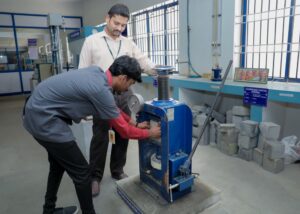
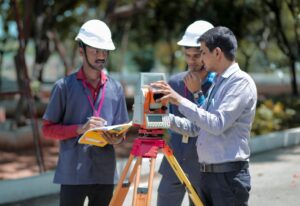
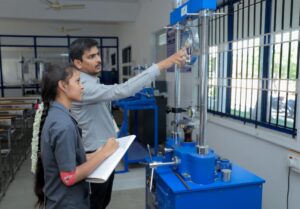
Laboratory


Professional Society (ICI)
NAME OF THE SOCIETY:
INDIAN CONCRETE INSTITUTE (ICI), CHENNAI,
Inaugurated By: 12.10.2012
Organizational Membership ID: 9799
FACULTY I/C:
Mr.V.RAGHUPRASATH, AP/Civil
OBJECTIVES:
- To promote growth of concrete construction and its sub-specializations.
- To disseminate information and to arrange to train personnel for the needs of changing concepts in the technology.
- To collaborate with national and international agencies in creating better understanding of concrete construction technology.
- To indentify R & D problems of practical relevance to concrete construction technology.
- To institute and distribute awards for outstanding achievements in concrete construction technology.
- To arrange periodical seminars and exhibitions on the subject and
- To arrange annual lecture series on selected topics of relevance to concrete constructions.
BENEFITS:
- One free Delegation to participate in ICI Events.
- Concessional delegation fee for Two for Institutional Member and Five for Commercial
- Member to participate in national and international events conducted by ICI.
- Receipt of 2 copies of quarterly ICI Journal which carries valuable technical articles.
- Receipt of monthly e-bulletin “ICI Update” to keep abreast of happenings in IC1.
- Publication of peer reviewed technical articles in ICI Journal.
- Publications of ICI at concessional cost.
- Access to ICI’s reference library.
- Support from ICI to conduct Training Programmes, Workshops, Seminars, Symposia etc.,
- Participation in ICI organized exhibitions to show case your Products/Services.
Report: